

The equipment and technologies that make up a biotherapeutic production process can represent an intimidating hurdle for many first-time operators. These drugs, the result of years of research and development, are often highly complex; as a result, many of those working in the industry today may assume that the instruments used to support their manufacture are just as complicated to employ.
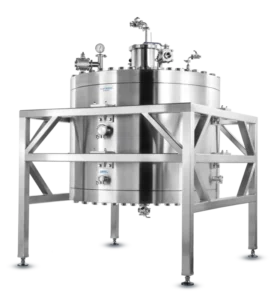
While chromatography columns have been refined and optimized to perform chemical separations across several biotherapeutic applications, their operation consists of a simpler and more straightforward process than many assume when encountering these pieces of equipment for the first time. In reality, these columns are static pieces of equipment that function in much the same way as a coffee press, separating relevant molecules from media and impurities to produce a final drug product – except in the case of chromatography, the “coffee/product” is retained, while the “grounds/waste” is flushed away.
Understanding how purifications work can help operators better conceptualize the process, enabling greater process understanding and troubleshooting. This is important, as establishing a fundamental understanding of every part of upstream and downstream processing can help operators avoid delays and optimize their production for expensive, challenging drug products.
Therapeutic Protein Production and Brewing the Perfect Cup
There are several key families of equipment that form the core of a production and purification process. The first is a bioreactor, designed to enable growth of cells, proteins, or other biologic processes. Downstream of the bioreactor is a fluid handling system, or a “skid,” which performs the blending, mixing, measuring, and monitoring necessary to facilitate further downstream processing. Then there are chromatography columns, which function as reaction vessels, separating what is necessary for the final drug product from what is unnecessary or harmful.

This process is, in many ways, analogous to making coffee – combining hot water and coffee grounds, for example, produces a reaction, creating coffee, while operating a column is akin to using a French press. The material from a bioreactor, transferred into a column, reacts with material in the packed bed in a similar way, before being filtered within the column similar to the way the plunger of a French press forces the grounds downward, allowing the coffee to separate from it without retaining “impurities.” While the exact processes occurring at the molecular level are very different, the results are similar – a final drug product like a cup of coffee, free of grounds, thanks to the filtration enabled by the column.

In fact, the process of producing injectable medicines is more comparable to making beer: combining the primary ingredients with water and mixing them to allow them to interact with one another to produce something new. In the same way that fermenting grain, malt, hops, and yeast produce alcohol, similar processes, applied to therapeutics, produce new proteins. Likewise, in the same way that fermenting beer has the potential to introduce unwanted impurities, growing proteins produces impurities that must be removed to safeguard human health. In beer making, this would require cooking the beer to remove these impurities.

Because that is not possible for proteins, this purification must occur at the molecular level inside the column. That is where we return to the coffee comparison, as this reaction occurs with the “grounds” – in this case, the purification media inside the reaction vessel. Typically, this media is in the form of tiny spheres coated with chemicals. These spheres, smaller than grains of sand, touch each other, with space between them despite being tightly packed within the column to allow the “primordial soup” produced in the bioreactor to pass between them. This liquid flows between these microscopic, nested ping pong balls, reacting with the chemical that has been charged onto the media. At this point, the reaction occurring is the opposite of coffee making – instead of hot water extracting flavor and color and caffeine from the coffee grounds, the grounds perform a chemical separation, and the wanted and unwanted materials flow out at different rates. Waste and pure product are subsequently diverted into different streams, then to a capture tank for subsequent processing.

Simple and Easy-To-Use: Chromatography Columns At-A-Glance
While these technologies are integral to a drug manufacturing process, they are not exceedingly complex; there are roughly 10 parts in a chromatography column, which functions chiefly as a hydraulic cylinder. Typically, these columns are made up of a main tube capped by a bottom and top plate, with an outer piston rod, an inner piston rod, an internal piston head and two distributor plates. A lift ring and collar spacer round out the instrument, with various seals and O-rings connecting these various parts.
Although there are a range of different chromatography columns on the market, such as Dynamic Axial Compression LC Columns for various particle sizes – HPLC, MPLC, UHPLC or Flash, their design and operation varies only slightly, and are designed for easy use. Whether it is 10 centimeters in diameter or 100, a column is a column: scaling from one size to the next is made simple by virtue of their design, and training operators on a small-scale column can prepare them to operate columns at much larger scales with only small differences in approach. Maintaining the simplicity and utility of these pieces of equipment is equally important for those on the drug development side; as developers scale, they can do so with the assurance that their chromatography scales seamlessly alongside their application.
Conclusion
The perceived complexity of biotherapeutic processing in general, combined with the reality that equipment operators in these manufacturing paradigms may or may not have technical backgrounds, has served to contribute to the idea that these systems are difficult to operate or to work on. Additionally, those who do possess technical backgrounds may be equally in the dark regarding how equipment such as purification columns work, owing to a lack of emphasis on these technologies as part of their training and education. Ultimately, purification columns are critical components of downstream drug processing; understanding their basic functions is crucial to maintaining a production paradigm that is optimized for success.