

In the past decade, oligonucleotide developments have certainly made a presence in the healthcare industry, however, it isn’t until the last five to ten years that investments in the sector have dramatically increased, making it a premier player in therapeutics. Most biologic drugs currently on the market focus on proteins whereas oligonucleotides cast visibility on flaws in genetic codes1. Delving into the root causes of diseases rather than the symptoms, oligonucleotide therapeutics act with specificity by selectively targeting difficult to pinpoint ribonucleic acid (RNA), ultimately reducing side effects in comparison to conventional methods. Due to its versatility, oligonucleotides are an effective solution to rare and formerly untreatable illnesses such as neurological disorders, infectious diseases, and cancers. “The list of diseases that oligonucleotides can target is ever-growing, with the market valued at USD 5.19 billion in 2020 and expected to rise to USD 26.09 billion by 2030.2

To meet growing demand, scaling oligonucleotide manufacturing from small research-grade quantities in laboratories to large-scale production suitable for therapeutic applications or extensive research studies comes with its own challenges and complex maneuvering in the manufacturing process. While fighting to increase output without compromising quality or specificity of the oligonucleotides produced, the major bottlenecks that producers face are derived from “high expenses regarding the raw materials for oligonucleotide synthesis, a lack of funding for oligonucleotide therapies, and a shortage of skilled resources in the oligonucleotide synthesis field. These problems create substantial bottlenecks in the research required for therapeutic oligonucleotides and, ultimately, the clinical use of these therapies.”3
Oligonucleotide manufacturing uses chemical synthesis to create oligonucleotides, in which nucleotides are added one at a time to form a developing chain. A sequence of chemical reactions is applied to every nucleotide in order to produce a stable component that permits the chain to extend. In recent years, solid phase synthesis has been the favored approach in oligonucleotide manufacturing with liquid phase synthesis used less frequently, but proving to have larger potential 10-20 years down the road with the correct technology.
Solid-Phase Synthesis
A process used in oligonucleotide manufacturing where the oligonucleotide chain expands from the first nucleotide in the sequence while being bound to a solid support. It is then placed in columns that enable all solvents and compounds to freely pass through.
Liquid-Phase Synthesis
An alternative method less commonly used in oligonucleotide manufacturing due to the advancements and efficiency of solid-phase synthesis. Unlike solid-phase synthesis, liquidphase synthesis does not require a solid support to stabilize the growing chain, instead the oligonucleotides are grown on soluble polymer supports. Nucleotides are then added to the growing chain that suspends freely in a liquid medium of homogeneous media.
Both approaches have their own advantages and disadvantages, and a method is selected depending on the operative purpose and goal. Liquid-phase synthesis takes longer to produce oligonucleotides in comparison to solid-phase synthesis, however it is considered a more ecofriendly option and does not require harsh solvents. Solid-phase synthesis is ideal when generating larger yields as it produces a fairly large amount of oligonucleotides.

When looking for oligonucleotide equipment and machinery for your facility, key component considerations are: does it include technology or features that streamline upscaling parameters? Does it offer robust automation capabilities and maximize yield and purity in the final product? Many aspects of the oligonucleotide manufacturing process require customization and even the need to use other equipment that can streamline into your current setup. Be on the lookout for suppliers that have readily available customization services and a streamlined product line.
Asahi Kasei Bioprocess has introduced several novel equipment innovations that address key aspects in synthesis, purification and increasing process efficiency. Global manufacturers can tackle growing demand for RNA and DNA therapeutics with optimized columns, systems, and automation solutions in oligonucleotide manufacturing.
One significant innovation is the THESYS™ Oligosynthesizer, a solid-phase flow-through synthesizer designed for mid-scale to large-scale oligonucleotide operations. This equipment offers a range of synthesis options from millimole (mmol) to mole (mol) scale with a high level of automation. The synthesizer features a patented valve design, with zero-static (ZS) inlet valve manifolds, which are created through computational fluid dynamics modeling.4 This technology is designed for easy and seamless scalability, while maintaining consistent full-length purity across scales and reducing wash volume requirements. Additionally, the THESYS Oligosynthesizer boasts advanced process controls for easier management and the capability to effortlessly streamline from other oligosynthesizers without disrupting processes.
To enhance the safety and efficiency of oligo production, Asahi Kasei Bioprocess also offers their line of THESYS C&D Systems. These systems automate the post-synthesis steps of cleavage and deprotection optimizing efficiency and allowing the oligosynthesizer to focus on its core functions. The C&D Systems are available in a range of flow rates to accommodate both DNA and RNA processes. They are customizable to meet specific manufacturing requirements, featuring options like chemically compatible deprotection vessels, integrated deprotection vessels for a turnkey solution, and OCELOT™ System Control for universally compatible automation software.5

THESYS™ Oligosynthesizer

THESYS™ Cleavage &
Deprotection System
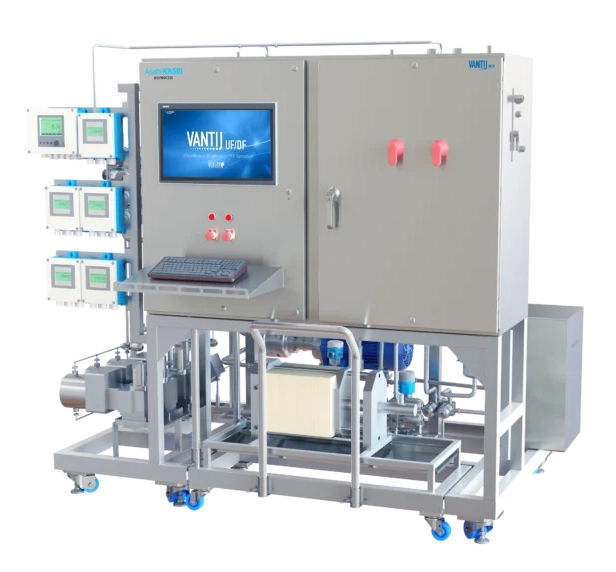
VANTIJ™ Ultrafiltration/
Diafiltration TFF System
For oligonucleotide purification and concentration, Asahi Kasei Bioprocess has developed the VANTIJ™ UF/DF TFF System. This system is a unique TFF system built specifically for oligonucleotide manufacturing with skids that are constructed to maximize the potential of every batch. Designed to enhance productivity and safety, this system plays an important role in the downstream process of oligonucleotide manufacturing.6
These are a few examples of technological advancements that are currently offered on the oligonucleotide manufacturing market. Innovations that offer increasing scalability, efficiency, and high-quality solutions for the synthesis, purification, and processing of oligonucleotides will continue to be sought out as the demand for oligonucleotide therapeutics grows.
References
- https://www.crbgroup.com/insights/pharmaceuticals/oligonucleotide-manufacturing
- https://www.cambridge-design.com/blog/could-oligonucleotide-manufacturing-advances-redefine-therapy/
- https://www.cambridge-design.com/blog/could-oligonucleotide-manufacturing-advances-redefine-therapy/
- http://fluidmgmt.ak-bio.com/products/oligonucleotide-synthesis/oligosynthesizer/
- https://fluidmgmt.ak-bio.com/products/oligonucleotide-synthesis/cd-ultrafiltration-diafiltration-tff-system/
- https://www.bioprocessonline.com/doc/ultrafiltration-diafiltration-tff-system-for-enhanced-oligo-purification-and-product-concentration-0001