

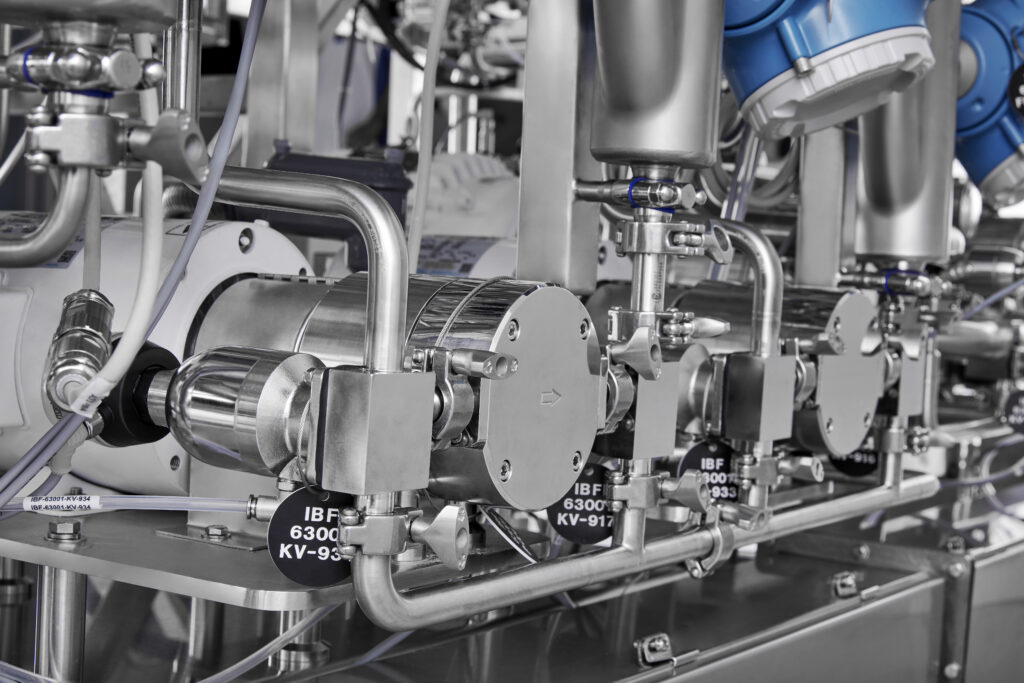
There are quite a few applications that require multiple streams to converge into a single process flow. Two such examples are buffer formulation and liquid chromatography gradient elution. In bioprocess applications, the required feeds are not typically pressurized, making it necessary to have a dedicated pump for each. A multi-head diaphragm pump is the optimal choice for low flow pulsation and high repeatability – these pumps must pull suction when primed in order to steadily drive process fluid from a bag or carboy into the system. Then again, WFI or PW utilities may reach the system at a much higher pressure than other process inlets. If this occurs, a sanitary liquid regulator can be used to balance the water inlet with all other contributing feeds.
While binary blending can be easily accomplished with this strategy – as with concentrate dilution or simple elution gradients – bioprocess blending can also combine several constituents at once. In such a case, accurate flow measurement can be accomplished by installing a flowmeter – such as a Coriolis mass flowmeter – on each feed stream; or by installing flowmeters on all feeds except WFI, calculating the remaining flow rate by deducting all other constituents from the instantaneous total flow. Once this is realized, each feed stream will have a flow rate process value that can be adjusted using a controller output to each corresponding pump.
In the case of buffer formulation, the target process parameter can be flow rate or downstream measurement of pH/conductivity for a given feed. It is important to note that in a single blending function only one stream can be assigned to affect conductivity and only one stream can be assigned to affect pH. For blends in which more than one constituent can affect these measurements, assignment of the two target process parameters will leave all other feeds controlled by flow. Blending control of multipart solutions can be achieved and optimized with this approach. Controller tuning and pump starting speeds can minimize out-of-spec run time. The actual blending can be accomplished with a static mixer, or for more stubborn solutions, a shear blender.
In the case of liquid chromatography elution gradients, there is an additional element of complexity. While they typically combine no more than three constituent feed streams, chromatography applications differ from buffer applications in their dynamic blend targets. A buffer preparation is expected to supply a consistent product from the start of the batch until the end. By contrast, a chromatography elution step may increase or decrease its blend proportions over time, generally in a linear manner. This requires a level of control that not only excels at maintaining a fixed target, but can also keep pace with a rising or falling target without drifting out of spec. Using the pump-driven approach succeeds at providing this dynamic capability.
For both applications, it is vital to command the equipment with robust, flexible automation software capable of maximizing the utility of the equipment’s pumps, instrumentation and overall design. With all these elements in place, achieving precise control over complex blends – whether they be for buffer or liquid chromatography purposes – should be well within reach.