

Traditional buffer formulation is often a time-consuming and labor-intensive process. From mixing components in large tanks to sampling to performing analytics in order to determine release parameters, these approaches typically require considerable back-andforth to arrive at the right final product. This time investment, coupled with the space required for tanks, piping, raw materials, and other operational components, as well as the cleaning and validation steps necessary to ensure compliance and quality, can equate to a massive operation, one that can compound significantly as a program scales.

As the biologics and advanced therapy spaces continue to grow, the need for more agile and adaptable processes supporting these modalities has yielded new and improved solutions to support their production. Downstream bioprocessing at increasingly larger scales requires intricate and diluted buffers. To address this need, Asahi Kasei Bioprocess developed its inline buffer formulation (IBF™) technology and MOTIV platform, enabling more cost-effective, just-in-time buffer preparation. Combined with features such as OCELOT System Control, an automation software platform that allows users to initiate production remotely, tweak process parameters on the fly, and interface with plant-wide control systems to achieve intuitive integration, these technologies serve to create a fully automated, highly consistent buffer formulation process
The process intensification made possible by MOTIV’s higher productivity and enhanced control can be leveraged for a wide range of buffer types; moreover, its comparatively small footprint, coupled with its nuanced and responsive method writing capabilities, make MOTIV an invaluable solution for applications trying to compete at commercial scales.
Leveraging Continuous, Responsive Buffer Formulation For Streamlined Manufacturing
For those performing traditional buffer formulation, whether a chemist, engineer, or site manager, meeting demand is rote, as making more buffer is simply a matter of taking an established recipe and multiplying for a final output. MOTIV takes this principle and automates it, enabling users to select a formulation and an amount and then generate the buffer on demand. Its method editor further simplifies this process, allowing users to easily tweak volumes and other parameters, flagging any potential errors before commencing production. This control extends to flow – because it follows a method as written with acceptable deviations predetermined by operators, MOTIV will shut down and alert operators if it cannot achieve one or more of a buffer’s parameters due to insufficient feeds.


MOTIV, which works by supplying buffer directly to the user, does not require the holding tanks of traditional buffer management systems. Additionally, its relatively small footprint – approximately two meters by two meters – allows it to fit into a customer’s existing facility with minimal workaround. Remaining tanks and solutions can often be stored outside a facility and supplied via pipeline, virtually eliminating the system’s footprint. Cleaning is commenced by process analytical technologies (PAT) at the end of a run, and the next run is initiated automatically unless the system is directed otherwise. At the end of every run, MOTIV generates a batch report detailing volumes, materials expended, water used, and concentrates incorporated.
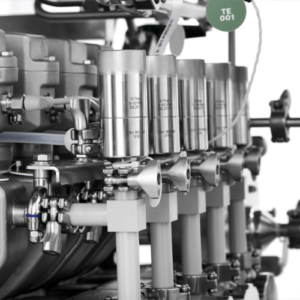
After setup, MOTIV is capable of fully automated, continuous operation. In contrast to buffer dilution systems, MOTIV offers users an array of analytical tools to measure variables such as conductivity or pH and can be integrated with high-performance liquid chromatography (HPLC) or medium-pressure liquid chromatography (MPLC) skids with the addition of a small intermediary buffer tank. For companies utilizing in-house or third-party software, MOTIV’s Open Platform Communications (OPC)-ready interface can easily integrate with another software or DCS system.
Simplifying and Automating Buffer Preparation with Motiv
Another time-consuming element of buffer formulation is recipe creation and editing – often, the process engineer who generated a recipe must be on-hand to monitor and adjust a recipe as needed in a traditional buffer formulation paradigm. This is where MOTIV’s OCELOT® software can serve to streamline these workflows through browserbased, remote method editing. Using any computer connected to an organization’s intranet or through a VPN, users can create new recipes, make and save changes, and access batch reports without needing to interact with equipment directly. OCELOT’s userfriendly interface walks operators through launching a run, from designating inlets and outlets to setting flow rates, and allows users to easily validate parameterized recipes and update them as necessary at point-of-use.


One of the more common problems operators encounter during buffer formulation with incumbent systems is a tendency to overshoot when trying to correct out-of-spec buffers. To take the guesswork out of PID parameters, OCELOT features built-in tuning parameters, so that, when buffer is running low, the system can predict, based on current conditions, what PID parameters will or should be. Another issue operators may run into relates to supply chain – if a run is ordinarily conducted using a solution at one concentration, for example, and operators are forced to utilize a solution at a different concentration, a MOTIV system will automatically adjust its formulation based on desired conductivity.
MOTIV has been tested for durations of as much as an hour producing buffer, and has been demonstrated to maintain acceptable analytical ranges, without deviation, during this timeframe, provided that enough water and concentrates are available. Users can specify either the length of a run or its volume and MOTIV will produce buffer until it reaches those requirements. If no time or quantity is given, MOTIV will continue to produce buffer until it is stopped, runs out of inputs, or encounters any hardware issues, such as a pinched hose. Depending on the complexity of a buffer, the first two to five minutes of a run may be sent to waste as the system works to achieve specifications; once a buffer is within spec, however, MOTIV will continue to generate it consistently. This means that wastage between a 500-liter run and a 10,000-liter run is the same, creating the potential for cost- and materials-saving as output increases.
Streamlined Workflows for Complex Buffers: Formulation Made Easy
Ultimately, an automated, integrated, responsive system like MOTIV can help eliminate the need for intermediate storage and reduce facility footprint. It can also, through its intuitive interface and reduction in site support, significantly reduce the time needed to produce buffer – often, MOTIV can produce enough in-spec buffer on demand within half an hour. AKBA has successfully trialed MOTIV with a wide range of buffers, from highly viscous glycerol-based formulations to buffers that utilize hard-to-dissolve chemicals to other unique, proprietary recipes. The variation MOTIV can handle is significant, and the system can integrate pH and conductivity as control parameters to ensure consistent pH throughout manufacturing and conductivity that can be raised or lowered depending on requirements. MOTIV is likewise able to recover quickly from upset conditions: if one of the hoses feeding concentrate into a formulation gets pinched and operators correct the problem, approximately within two minutes the system resumes production, enabling greater continuity for downstream operations.
For operators that want to bring down run times, engaging in data reviews to generate new parameters can help them arrive at in-spec buffers in the stable zone that can be produced faster and with less wastage. Because there are often multiple ways to make a buffer, operators can also frequently identify less expensive solutions that achieve the same goals – standard sodium acetate buffers, for example, may be made by dissolving sodium acetate in water, but a cheaper alternative may be to use acetic acid and sodium hydroxide to arrive at the same buffer. While users can iterate on recipes to improve MOTIV’s performance, AKBA also offers user support in order to enable continuous improvement. It continues to integrate new capabilities into its OCELOT platform, including adding automated cleaning steps and sensors that flag when concentrates are low. This is in concert with more recent integrations geared toward furthering this automation, such as bag weighing systems, heat exchangers, and even scanners that act as an additional line of defense for operators by ensuring that expired materials do not get introduced to a buffer.
Because most manufacturing processes consistently require buffers and in large quantities, ensuring that their production is as timely and cost effective as possible can go a long way in optimizing scale-up and commercialization. Through its innovative, flexible design, MOTIV provides customers with equipment capable of meeting their buffer formulation needs for years to come. Combined with OCELOT, MOTIV offers customers the ability to reallocate their human resources to more intensive parts of a manufacturing process, regaining time and manpower that would otherwise be spent reformulating and testing solutions produced more traditionally.
