

Buffer can be a somewhat underrated staple of the pharmaceutical manufacturing process. Large-scale manufacturers can spend, on average, anywhere from $20 to $50 million per year on buffers1 and “7 out of 10 downstream equipment types with the longest occupancy duration are buffer related.”2 The traditional management of buffers has done little to mitigate key bottlenecks for manufacturers; but innovations in buffer management have begun to surface that help lower costs, improve efficiencies and flexibility, and reduce space and labor requirements. With a more varied array of solutions, it is essential to note the nuances dependent on factors such as the size of the facility, planned scalability, and more. The five most significant considerations when choosing a buffer management solution will aid manufacturers trying to decide which is suitable for their unique circumstances.
In-House or Outsource?

Selecting whether to procure a buffer solution or make one in-house is an important first step in the evaluation process. Procuring a solution from a commercial vendor is seen as more beneficial for smaller, intermittent manufacturers. An in-house solution takes up more space, requires additional expertise, and increased operational costs. These smaller facilities may benefit by avoiding allocating the required resources to generate buffers while accessing solutions made with high-quality ingredients. Additional benefits include reduced compliance/EHS risk, lowered complexity, decreased in-house QA/QC testing, allocating expert staff members to work on different value added tasks, and expanded flexibility in shifting molecules and operations. The main drawbacks of going with an outsourced vendor are related to direct quality control and cost. QC risk can be mitigated through a rigid evaluation process. Unfortunately, the price is historically harder to diminish given, on average, the most significant cost consideration for outsourcing is shipping heavy buffer solutions. Newer technological innovations, such as buffer blending, make it possible to reduce outsourcing costs because instead of sending a full, premade buffer solution, they can ship concentrates to be mixed with WFI onsite.
An in-house solution is traditionally proven to be more cost beneficial, with estimated buffer costs ranging $4-$6/L in-house vs. $8-$15/L outsourced3. This is incredibly relevant as a facility scales up. Another benefit of having an in-house solution is direct quality control and more accessible on-the-go formula manipulation. The drawbacks of this option lie in the resource cost of space, labor, and potential timeline interruptions. Such drawbacks have been reduced in recent years with the growing number of alternatives – such as inline buffer formulation – that make it possible to efficiently produce more solutions in-house, all within a smaller footprint.
Which Type of Buffer Management Solution is Right for You?
Factors to consider when choosing a buffer management solution include optimizing cost, time, space, as well as labor effectiveness, resourcing, and flexibility. The following are industry buffer management methods with associated strengths and weaknesses.

Traditional: Large quantities of various buffers set at the final designated concentration are prepared ahead of time before being transferred to the process. Challenges of traditional buffer preparation relate to preparation and storage requirements – in addition to personnel and time demands. These drawbacks are not to say that the traditional method should be overlooked; however, there are more innovative options on the market that can mitigate these pain points and be better utilized for increasingly complex projects.
Inline dilution: A buffer that initially starts with concentrated salt solutions that are pH-adjusted and diluted with water. Subsequently, they are mixed and sent to processing. Advantages of buffer concentrates are reduced operating and buffer costs and a positive impact on labor demand and footprint.4 Due to the reduction of solution usage and avoiding buffer hold stages, inline buffers are suited to just-in-time delivery. Some setbacks from this method reside in strictly adhering to project specifications for pH. Mixing effectively is required to proceed to the process phase and to avoid preparation of products that fall outside of specifications.
Buffer formulation: Buffers prepared on demand from single-component stock solutions concentrated at the required level and delivered to processing. Buffer stock formulation is flexible, and due to the large volumes involved, it is optimized – and cost-saving – for larger-scale projects, particularly if the preparation of the solution concentrate is outsourced.
What Types of Buffer Do I Need Now and in the Future?
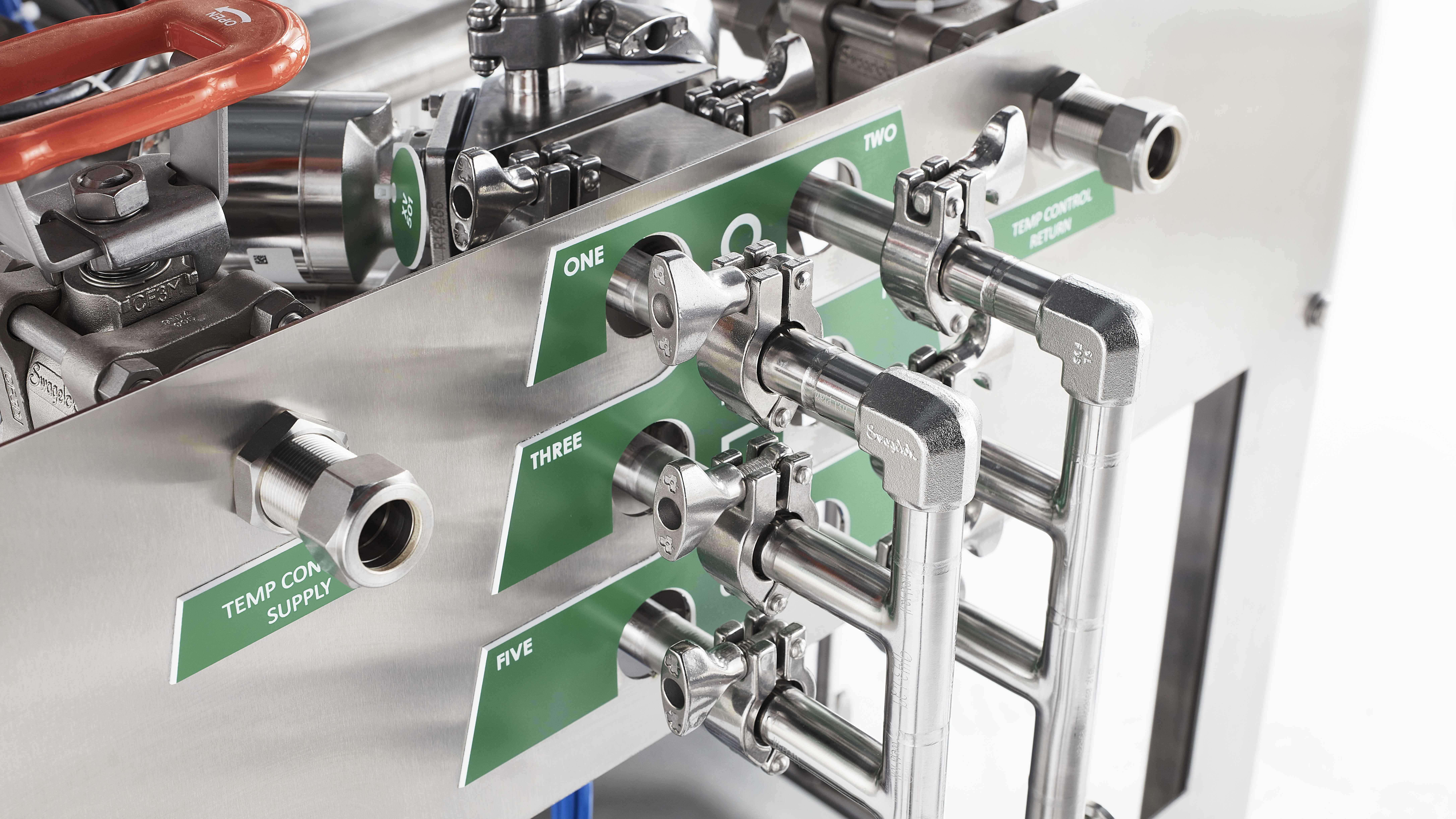
This question helps define the type of equipment that can effectively handle your current and future workloads. Common excipients are histidine (especially in antibody formulations), phosphates, citrate, acetate, and sodium hydroxide.5 There is sometimes a need for other reagents such as glycerol which adds protein solubility and stability but has a relatively higher viscosity. If a manufacturer is handling these substances in the buffer solution creation process, it is pertinent to investigate equipment that can quickly dilute these highly viscous fluids. An average manufacturing facility will need a minimum of 10-15 buffer solutions, many requiring as many as 40. Choosing the right equipment is key to reducing the buffer bottleneck, and several great options are emerging in the market. Most notably, the improvements brought by a formulated buffer solution may be advantageous for facilities of all sizes due to their versatile and efficient nature. For instance, an inline buffer formulation system – such as the MOTIV 310 – can effectively process viscose reagents by providing a 20X dilution of 100% of glycerol within minutes. Even the largest facilities that benefit significantly from the traditional buffer management equipment may be able to add and incorporate a buffer formulation machine to their repertoire. This would add flexibility, optimize facility space, improve timelines, minimize waste, and still improve operational costs.
Single-Use or Fixed Vessel?

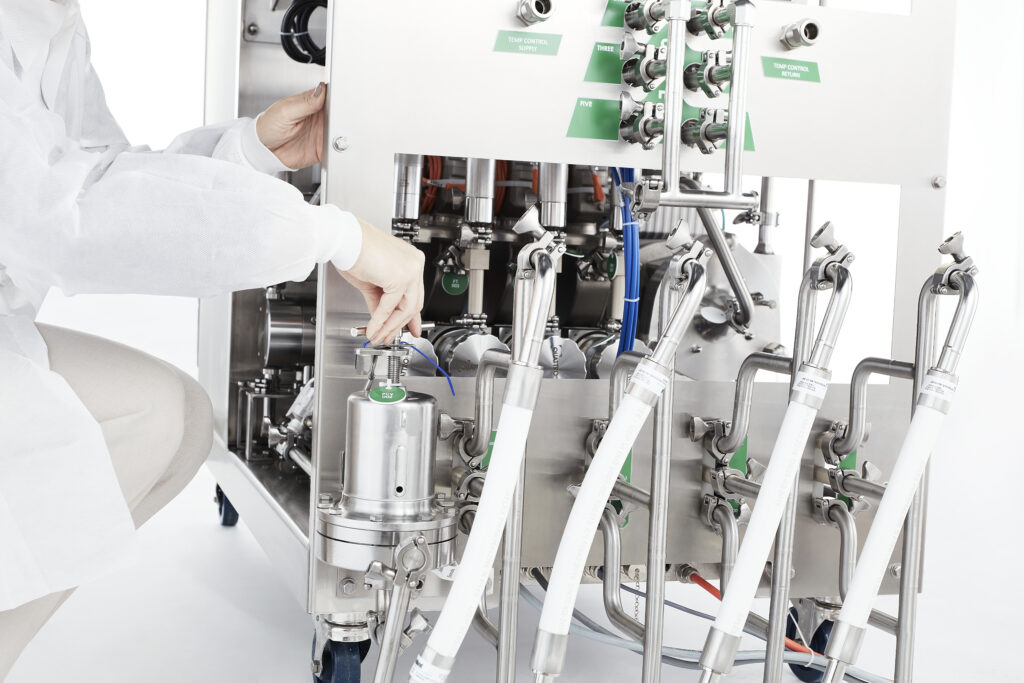
The primary choice of containers for solutions in biopharmaceutical manufacturing is single-use or fixed stainless-steel vessels. Aside from the ecological footprint component, which has many contributing factors such as waste, water usage, space, and electricity – this choice impacts the overall system cost and usability. The upfront cost of buffer management equipment will be higher if the traditional stainless steel is chosen over single-use plastic. It is important to note that the respective cost-savings related to using single-use initially, at a large scale, can be offset due to the increase in costs of the associated consumables during operation. The more flexible solutions for buffer management, such as buffer blending, effectively utilize single-use totes for versatile production, and this increased adaptability is impossible with stainless-steel vats. In general, it is safe to say that for a new, smaller facility or for a facility that is producing a smaller volume of multiple buffers, it is more cost and space effective to go with single-use containers. In contrast, larger facilities or facilities producing greater volumes of buffer will still typically see more significant cost savings overall from the use of stainless-steel fixed vessels, at least for their extremely high-volume requirements.
Integrating Technology – The Systems
As growth in the biopharma manufacturing industry continues to accelerate, combining software, hardware and single use encourages a user-friendly process within a compact system. As a result, the industry needs to be equipped to meet the growing opportunities by considering on-demand buffer management systems and processes. Consistency, flexibility, rapid turnarounds, and risk management are pivotal factors in considering buffer management solutions, especially ones that align with the on-demand type supply delivery that is seen in today’s biopharma manufacturing space. Traditional approaches such as seeking external sources and contracts to aid in the buffer formulation stage limit production freedom and are ill-suited for tackling increasingly complex buffers with varying preparation and application. Utilizing automated systems offers greater efficiency in downstream production on the commercialized level. In addition, it can be customized to meet every project’s unique specifications.

Cutting-edge in-house systems are easily integrated with the facility’s existing system creating a process ecosystem that allows for remote and automated production as well as increased productivity with faster turnarounds and interfacing. For example, the benefits of in-house buffer formulation systems will enable the production process to skip steps involving additional testing such as mixing, adjustments, and ultimately executing complex replications on a mass scale with precision. In addition, automated buffer management systems may come with universally compatible software that combines data collection and analysis to facilitate smooth production and record-keeping.
Addressing supply chain and manufacturing bottlenecks is the best launching pad for the biopharmaceutical industry to collaborate and advance through trends and challenges. As the sector accelerates and complex projects bloom, industry leaders call to attention flexibility in buffer preparation and mindfulness in economic impact. Focus on support services, such as buffer preparation, will play an integral part in the long-term strategy to combat increasing overhead.
References:
- https://www.contractpharma.com/issues/2016-09-01/view_columns/economics-of-in-house-buffer-preparation
- https://www.genengnews.com/sponsored/how-effective-buffer-management-facilitates-biopharmaceutical-production/
- https://www.biophorum.com/wp-content/uploads/bp_downloads/An-economic-evaluation-of-buffer-preparation-philosophies-forthe-biopharmaceutical-industry-December-2019.pdf
- https://www.biophorum.com/wp-content/uploads/bp_downloads/An-economic-evaluation-of-buffer-preparation-philosophies-forthe-biopharmaceutical-industry-December-2019.pdf
- https://pubs.acs.org/doi/10.1021/acs.molpharmaceut.1c00469